
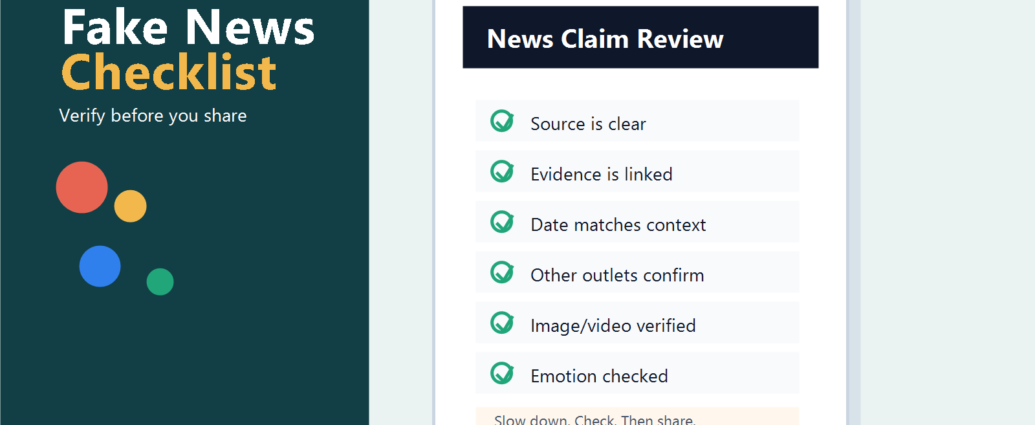
Learning how to identify fake news is now a basic online survival skill. A false headline, an old photo shared as new, a fake quote screenshot, or an AI-generated image can travel across social media before most readers have time to check it. The good news: you do not need to be a professional journalist to slow the spread. A few practical checks can help you decide whether a story deserves your trust, your attention, or your share.
Fake news is not always a completely invented article. It can be a real image placed in the wrong context, a misleading headline attached to a partly true story, a satire post stripped of its label, or a claim repeated by pages that never show original evidence. That is why the best approach is not cynicism. It is calm verification.
Quick Answer: How to Identify Fake News
To identify fake news, check the source, read beyond the headline, look for the original evidence, compare the claim with trusted outlets, inspect images and videos for old or manipulated context, use fact-checking tools, and pause before sharing anything designed to make you angry, scared, or instantly certain.
1. Check the Source Before the Story
Start with the website or account behind the claim. A trustworthy news source usually has an about page, editorial standards, contact information, named writers, corrections policies, and a history of publishing accountable reporting. A low-trust site may hide ownership, use a lookalike domain, publish anonymous stories, or fill pages with dramatic claims that lead nowhere.
Look carefully at the domain name. Fake or misleading sites often imitate familiar brands by adding extra words, strange endings, or small spelling changes. If a headline claims to come from a known outlet, open that outlet directly and search for the story there.
2. Read Past the Headline
Headlines are written to win attention, and misleading content often depends on readers reacting before they read. Open the full story. Ask whether the headline matches the article, whether the article provides evidence, and whether the key claim appears in the first few paragraphs or only in vague language.
If the headline says something shocking but the article only says “reports suggest,” “people are saying,” or “sources claim” without naming documents, witnesses, or official statements, treat it as unverified.
3. Check the Date and Context
Old stories often return during breaking news moments because they look fresh when shared without context. A real photo from 2018 can mislead readers in 2026 if it is posted as proof of something that happened today. Before sharing, check the publication date, the location, and whether the article has been updated.
This matters especially for disasters, celebrity rumors, elections, health claims, crime stories, and viral videos. The content may be real, but the context may be false.
4. Look for Original Evidence
Good reporting points readers toward evidence: official documents, direct statements, court records, public data, named experts, eyewitness accounts, images from the scene, or links to primary sources. Weak content often quotes other blogs, social posts, or unnamed “insiders” without giving readers anything to verify.
When a story makes a serious claim, ask: where did this information first come from? If every article links to another article and none link to the original source, the claim may be riding a loop of repetition instead of evidence.
5. Compare the Claim With Trusted Outlets
Major events are rarely covered by only one unknown website. If a claim is true and important, other credible outlets will usually report it too, even if they add caution or different details. Search the exact claim in a search engine and compare how established newsrooms describe it.
You do not need every outlet to agree perfectly. In fact, real reporting often includes uncertainty. What you are looking for is whether reputable sources are covering the same core facts and whether they point to evidence.
6. Inspect Images and Videos Carefully
Images can be powerful, which makes them easy to misuse. A viral photo may be old, cropped, staged, edited, AI-generated, or taken from a different country. Use reverse image search when a photo seems suspicious. Look for earlier uploads, matching landmarks, weather, signs, uniforms, license plates, and whether the image appears in older articles.
AI-generated visuals can also include warning signs: strange hands, inconsistent shadows, unreadable text, unrealistic reflections, odd background details, or faces that look too smooth. None of these signs is perfect on its own, but contradictions are a reason to slow down and verify.
7. Use Fact-Checking Tools
Before sharing a viral claim, check whether it has already been reviewed. FactCheck.org explains practical ways to combat misinformation, including slowing down before resharing and checking trusted sources. Google’s Fact Check Explorer can also help you search fact-checks from publishers around the world.
The News Literacy Project is another useful resource for understanding misinformation, disinformation, false context, fabricated content, and manipulated media.
8. Notice Emotional Triggers
Fake news spreads because it makes people feel something fast: anger, fear, pride, disgust, panic, or instant agreement. If a post seems designed to make you react immediately, take that as a signal to pause. Strong emotion does not prove a claim is false, but it can make careful checking harder.
A simple rule helps: the more a post pressures you to share now, the more you should verify first.
9. Separate News, Opinion, Satire, and Ads
Not every misleading post is pretending to be straight news. Some content is opinion, sponsored content, satire, or commentary clipped out of context. Check labels, page descriptions, and disclaimers. Satire can become misinformation when screenshots travel without the original label.
Opinion articles can still be valuable, but they should not be treated as verified reporting unless they provide evidence. Sponsored posts should be read with awareness of who benefits from the message.
Fake News Examples to Watch For
- Fake celebrity death posts: These often use emotional headlines and ask readers to click before any credible outlet confirms the news.
- Old disaster photos: Real images from past floods, fires, or protests may be reused to create panic during a new event.
- Fake quote screenshots: A quote placed on a politician, athlete, or celebrity image is not evidence unless it links to a reliable original source.
- Imposter news pages: Some websites and social accounts copy the style of real news brands while using unofficial names or lookalike URLs.
- AI-generated breaking news images: These can look convincing at first glance but may fail when checked against trusted reporting and visual details.
How Fake News Spreads So Fast
Fake news spreads quickly because it is built for attention. Social platforms reward content that gets reactions, and false claims often use simple emotions, dramatic visuals, or identity-based messages to drive clicks. Many people share misinformation without intending to mislead anyone. They may believe they are warning friends, supporting a cause, or reacting to a breaking situation.
That is why media literacy matters. A healthy news habit protects both the reader and the people who trust that reader. At Today’s News Journal, our aim is to help readers approach the news with curiosity, evidence, and context. Readers can also contact us if they notice an article that needs review or correction.
A Simple 60-Second Fact-Check Routine
- Open the full story instead of reacting to the headline.
- Check the site, author, date, and URL.
- Search the exact claim in another tab.
- Look for the original document, video, statement, or data.
- Reverse-search suspicious images.
- Check a fact-checking tool for viral claims.
- Wait before sharing if the post makes you feel pressured.
FAQ
What is the easiest way to spot fake news?
The easiest first step is to check whether the same claim is reported by credible sources and whether the article links to original evidence. If only unknown pages are repeating it, pause before trusting it.
Is every wrong article fake news?
No. Journalism can include errors, updates, and corrections. Fake news usually refers to false or misleading content presented in a way that makes readers believe it is reliable news. Intent can be hard to prove, so it is often better to focus on whether the evidence supports the claim.
How can I fact check news online quickly?
Search the claim, compare coverage from reliable outlets, check the original source, use reverse image search for photos, and look for fact-checks from established organizations.
Can AI images be used as fake news?
Yes. AI images and videos can be used to create false impressions, especially during breaking news. Check whether trusted outlets have verified the image and look for visual contradictions or missing context.
Bottom Line
The best way to identify fake news is to slow the moment down. Check the source, confirm the evidence, compare with trusted reporting, and avoid sharing posts that rely on shock more than proof. A careful reader is one of the strongest defenses against misinformation.
For more updates and reader-focused explainers, visit our newsletter page.
Comments are closed, but trackbacks and pingbacks are open.